
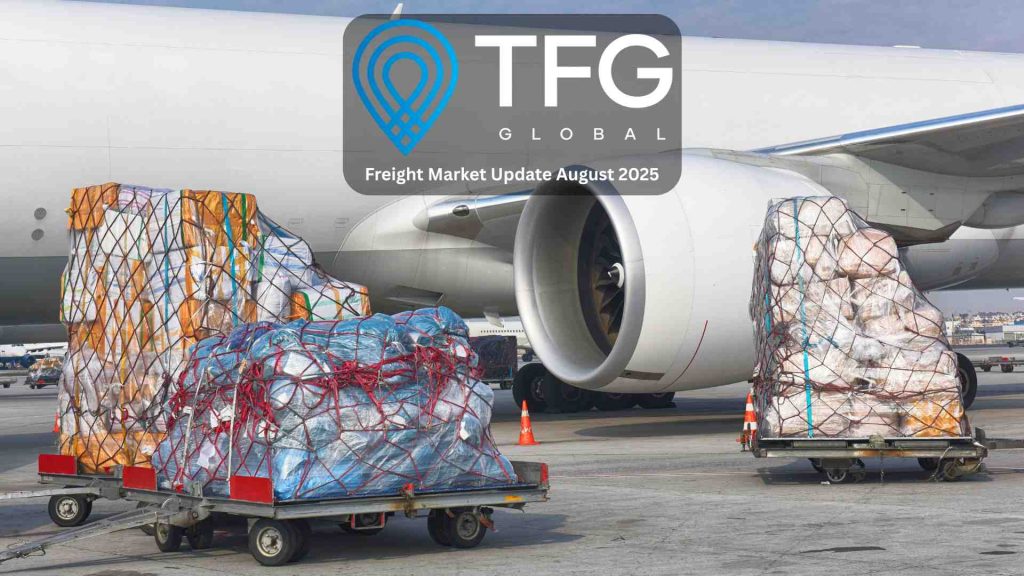
Freight Market Update August 2025 opens with a world in motion, both literally and figuratively.
Global shipping is walking a fine line between stabilisation and disruption as rates cool from earlier highs, while weather, geopolitics, and shifting alliances keep schedules on edge. Sea freight is seeing improved reliability, air cargo is holding steady, and several key trade lanes are bracing for peak season surges.
At the same time, carriers are juggling capacity like a high-stakes puzzle, testing rate levels without tipping the balance. This month’s update takes you through the global picture, regional hot spots, and the small but significant changes that could ripple through your supply chain.
Global Overview
Global schedule reliability continued its climb in June, reaching 67.4%, up 1.6 percentage points month-on-month and marking the highest point since November 2023. That is five straight months of improvement and a 12.8-point year-on-year jump. Maersk led at 81.0%, closely followed by Hapag-Lloyd at 76.5%, while Yang Ming trailed at 55.4% (source).
Since the launch of the new alliances in February, the industry has tracked both “all arrivals” and “trade arrivals” to provide a fuller performance picture. In May and June, the Gemini Cooperation dominated with over 93% reliability on all arrivals, MSC maintained mid-70% performance, and the Premier Alliance lagged in the mid-50s. The Drewry World Container Index dipped just 1% this week, signalling stabilisation after months of tariff-fuelled swings (source).
Airfreight Trends
Late July brought a rare moment of calm to global air cargo markets. Asia Pacific to U.S. lanes saw volumes recover, with China up 4% week-on-week and Hong Kong up 5%, while South Korea’s rates rebounded 29% after a sharp drop the previous week, reaching their second-highest level this year at $6.01/kg. Asia Pacific to Europe stayed sluggish, with Japan seeing a 10% decline.
Overall, tonnages and rates held largely steady, with worldwide averages around $2.45/kg (source).
IATA’s June data showed air cargo demand up just 0.8% year-on-year, down from 2.2% in May, as trade uncertainty persisted. Asia-Pacific still posted strong growth at 9% year-on-year, but North America saw an 8.3% drop (source).
Australia: Terminals and Tariffs
Sydney’s Qantas Freight terminal upgrades are boosting efficiency with new temperature-controlled storage, automated systems, and improved landside-to-airside flows. Fremantle Ports will raise mooring and handling fees from October, while also recovering from early July’s weather-related two-day shutdown. Brisbane terminals faced minor disruptions from system upgrades, while Adelaide secured industrial peace through 2029 with a new in-principle agreement with the Maritime Union of Australia. Tariff changes are set to reshape costs: the global end of the de minimis exemption on 29 August means all low-value imports will face tariffs, and 50% duties now apply to copper and Brazilian goods. A 25% tariff on Indian imports took effect on 1st August, with a potential 15% U.S. tariff on EU autos, pharmaceuticals, and semiconductors still under discussion.
USA and Canada
The August 1 General Rate Increase was withdrawn, and Peak Season Surcharges have been removed for the month, leaving rates steady, particularly on East Coast and Gulf lanes. Spot rates continued to soften, with Shanghai–Los Angeles down 2% to $2,632/FEU and Shanghai–New York down 2% to $4,135/FEU, as the pre-tariff rush faded. Carriers are adjusting by blanking more sailings to maintain stability. MSC announced that it will launch its standalone Eagle Service from Australia and New Zealand to the U.S. East Coast in February 2026, with calls to Philadelphia, Savannah, and other key ports.
Asia-Pacific: Peak Season Pressure
The Asia Pacific corridor is in full seasonal mode, with blank sailings, congestion in Shanghai and Busan, and typhoon disruptions driving volatility. Carriers have pushed rates into four-digit territory and are layering on General Rate Increases of USD 300–500 per TEU along with Peak Season Surcharges of USD 350 per TEU. From 8 to 14 August, competitive carriers dropped base rates slightly to ensure full utilisation, while premium services held firm at higher price points. Southeast Asia remains more stable, although feeder delays and equipment shortages at Singapore and Port Klang are tightening space. ANL, TS Lines, and MSC are adding extra vessels in August and September, but demand is quickly absorbing capacity. Space out of China and Vietnam remains extremely tight, with bookings often needing to be secured four weeks in advance.
India and South Asia
Chittagong port congestion is stretching vessel waits to between 6 and 10 days, compounded by yard overflows and rail delays. Colombo’s transhipment hub is facing one to two week delays under monsoon conditions, while Indian ports such as Mundra and Nhava Sheva are also experiencing weather disruptions that add to schedule slippage.
Europe: Congestion and Caution
FEWB rates are holding 5 to 8% higher than late July, with strong vessel utilisation likely to push rates higher in September. TAWB lanes remain steady, though the East Mediterranean is beginning to see General Rate Increases for September. Antwerp is experiencing its worst congestion since COVID, with dwell times beyond eight days, while Rotterdam and Hamburg are also heavily utilised. Southern European ports like Genoa and Valencia are struggling with high yard density and labour shortages, while the Netherlands’ RWG terminal has vessel waits of up to 10 days. From 1 October, German ports will switch to a secure digital container release system to improve pickup security and efficiency.
Global Trade and Geopolitics
The second half of 2025 is shaping up to be economically uneven. The U.S. economy is slowing, Europe and China face weak demand, and geopolitical tensions are disrupting flows. Renewed U.S. tariffs, a U.S.–Vietnam agreement imposing 20% tariffs, and a 15% U.S.–EU tariff baseline are raising costs. In the Middle East, conflict involving Iran, Israel, and the U.S. is affecting shipping lanes, while in Asia, typhoon activity and disputes such as Cambodia–Thailand border closures are disrupting regional trade. The Red Sea remains a security hotspot, with recent Houthi attacks sinking two Greek-operated ships.
US Freight Market
Spot rates have plunged, down 60% on the West Coast and 30% on the East Coast, as tariff pauses led to front-loaded imports followed by a slowdown. Capacity cuts are expected in August. CMA CGM has reflagged the 9,300 TEU CMA CGM Phoenix to the U.S. flag, now the largest in its category, supporting domestic maritime jobs and national security.
Sustainability and Equipment
The push to net-zero shipping by 2050 continues, though infrastructure gaps remain. Orders for alternative-fuel vessels surged 78% this year, with LNG leading but methanol, ammonia, and hydrogen gaining traction. Australian exporters are facing equipment shortages, especially for reefers and 40 foot containers.
Cancellations
Blank sailings dropped in July but are set to rise again through late August, with 48 announced for Weeks 31 to 35, affecting Transpacific, Asia–Europe, and Transatlantic routes. On the China–Australia lane, June’s cancellation rate rose to 6.6% from May’s 5%, showing that volatility remains and that flexibility in planning is vital.
The Takeaway
Freight Market Update August 2025 shows a market walking a tightrope, with stability on one side and disruption on the other. Carriers are testing rates, and schedules are improving, but weather, tariffs, and geopolitics mean flexibility is essential. Whether shipping across oceans or through the skies, early bookings, diversified routings, and close monitoring of policy changes will help keep cargo moving smoothly.
—
When it comes to freight forwarding, we are the full package. Market-leading service, values, and solutions.
For all your freight-forwarding solutions, internationally and Australia-wide, you need TFG Global.
Phone: 1300 (693 734) MY FREIGHT | +61 3 9090 7546
Email: andrew@tfgglobal.com.au
Web: www.tfgglobal.com.au