
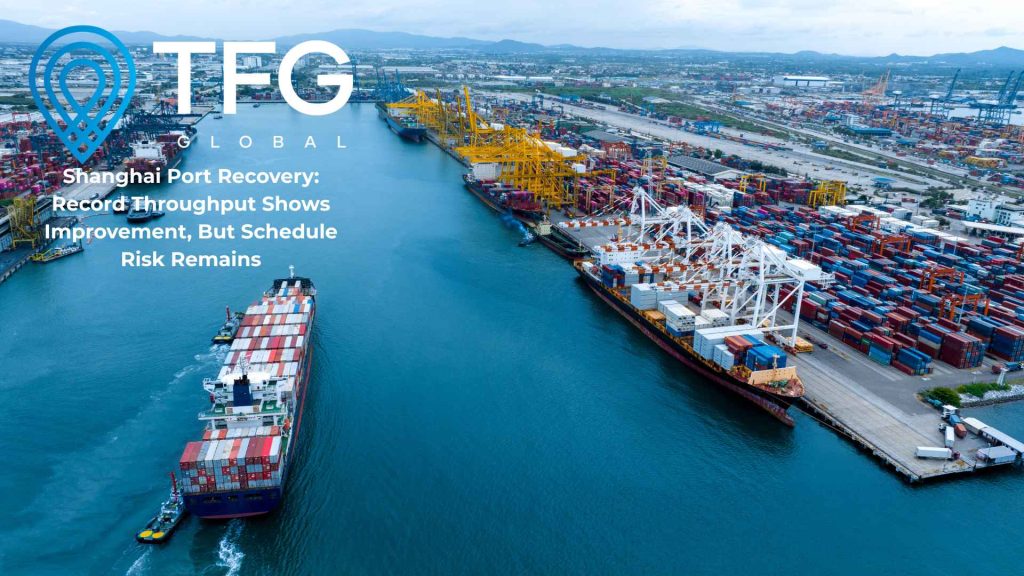
According to Global Times reporting, Shanghai Port’s single-day container throughput surpassed 200,000 TEUs, reaching a record 203,881 TEUs after recent disruption from Typhoon Bavi. The same report said Typhoon Bavi disrupted vessel operations at Shanghai Port for about four days in mid-July, creating pressure across berth availability, vessel clearance and yard turnover.
That is a positive signal.
It shows that Shanghai has been able to move quickly through a significant backlog after earlier weather disruption. It also highlights the scale, resilience and coordination capability of one of the world’s busiest container ports.
But it does not mean the risk has fully cleared.
For importers, the key message is simple: the Shanghai Port recovery is improving, but schedule risk remains.
Shanghai Port Sets New Daily Throughput Record
Shanghai Port reportedly handled 203,881 TEUs in a single day, setting a new record for daily container throughput.
Global Times reported that Typhoon Bavi disrupted vessel operations at Shanghai Port for about four days in mid-July. During that period, a large number of trunk and feeder vessels waited offshore for shelter before arriving at the port at the same time.
That created pressure across berth availability, vessel clearance, container yards and terminal operations.
Shanghai International Port Group has since reported that coordinated recovery measures helped the port clear vessel backlogs and restore terminal capacity. During the recovery phase, daily container throughput reportedly remained stable at around 172,000 TEUs before the port reached its new single-day record.
For the wider market, this shows that Shanghai is not simply stuck in disruption mode. The port is recovering and moving large volumes again.
Why This Does Not Mean the Risk Is Over
The record throughput number is encouraging, but importers should read it carefully.
High throughput can show recovery.
It can also reflect the amount of backlog that needed to be cleared.
When a major port processes record volumes after a disruption, it often means vessels, containers and cargo flows have arrived in concentrated waves. That can improve overall clearing speed, but it does not automatically remove risk for every individual shipment.
Importers may still see:
- Vessel bunching
- Changed ETDs
- Changed ETAs
- Rolled containers
- Berth waiting time
- Yard pressure
- Port omissions
- Delayed feeder connections
- Slower container turnaround
- Less reliable schedule information
The issue is no longer only whether Shanghai Port can recover.
The issue is whether each individual shipment has loaded, departed and remained on schedule.
China Export Schedules Still Need Watching
The Shanghai Port recovery is a good sign, but China’s wider export network still needs to be monitored.
Shanghai, Ningbo, Yantian, Shekou and Nansha are all part of a broader export network. When one port is disrupted, vessel rotations, cargo flows and carrier schedules can shift through other gateways.
This was already visible in July, when earlier typhoon disruption affected Shanghai and Ningbo, while South China ports also came under pressure from delayed and rerouted vessels.
For Australian importers, the practical risk remains the same.
A booking confirmation is not the same as a loaded container.
Until the cargo has physically loaded, the shipment can still be affected by vessel changes, rolled bookings, revised cut-offs or port congestion.
Ningbo and South China Still Need Watching
Ningbo remains an important area to watch because of its close relationship with Shanghai and East China export flows.
When Shanghai is delayed, Ningbo can come under additional pressure. When Ningbo is delayed, some cargo may move through alternative ports or later sailings. Either way, the schedule risk can spread.
South China also remains exposed.
Yantian, Shekou and Nansha remain important gateways for Australian importers moving consumer goods, industrial components, building products, retail stock and manufacturing inputs.
Even where headline waiting times are lower than Shanghai, disruption can still affect specific vessels, services and cut-off windows.
Importers should not assume that cargo is safe from delay simply because it is not moving through Shanghai.
What This Means for Australian Importers
This update is more positive than the earlier China port congestion bulletins, but it is not an all-clear.
Shanghai’s record throughput shows that recovery is progressing. That is good news for the market.
However, Australian importers should continue to allow for schedule volatility while backlogs, vessel bunching and weather-related recovery effects work through the network.
The most likely issues remain:
- Later-than-planned departures
- Rolled containers
- Vessel omissions
- Missed transhipment connections
- Changing ETAs into Australia
- Short-notice carrier schedule changes
- Customer delivery dates becoming harder to confirm
This is particularly important for time-sensitive cargo, seasonal stock, machinery, spare parts, project cargo and goods linked to installation or production deadlines.
What Importers Should Do Now
Importers with cargo moving from China should continue to manage shipments actively.
Recommended steps include:
- Check whether the container has actually loaded.
- Confirm whether the vessel has departed.
- Review updated ETDs and ETAs.
- Ask whether the booking has been rolled.
- Check whether the vessel is omitting any ports.
- Allow extra buffer for cargo moving through Shanghai and Ningbo.
- Monitor South China ports including Yantian, Shekou and Nansha.
- Avoid promising customers firm delivery dates based only on original schedules.
- Speak with suppliers about cargo readiness and gate-in timing.
- Keep freight partners updated on urgent or high-priority shipments.
If cargo is time-sensitive, the most important question remains:
Has it loaded?
Until the container is physically on board the vessel, the shipment remains exposed to changes in schedule, space allocation and port conditions.
TFG Global Recommendation
Shanghai Port’s record throughput is a positive sign and suggests recovery efforts are gaining traction after Typhoon Bavi.
However, Australian importers should not treat this as a full return to normal across China’s export network.
The Shanghai Port recovery story is encouraging, but the operational detail still matters.
TFG Global recommends importers keep checking shipment status closely over the coming week, especially for cargo moving through Shanghai, Ningbo, Yantian, Shekou and Nansha.
The market is improving, but a shipment is only safe from rollover risk once it has actually loaded.
If you have urgent cargo moving from China, speak with the TFG Global team before making firm delivery commitments.
We will continue monitoring the situation and providing updates while China shipping delays remain relevant for Australian importers.
—
When it comes to freight forwarding, we are the full package. Market-leading service, values, and solutions.
For all your freight-forwarding solutions, internationally and Australia-wide, you need TFG Global.
Phone: 1300 (693 734) MY FREIGHT | +61 3 9090 7546
Email: andrew@tfgglobal.com.au
Web: www.tfgglobal.com.au
Disclaimer
TFG Global makes reasonable efforts to ensure the information contained in this publication is accurate and current at the time of writing. However, freight markets, carrier operations, regulatory requirements, and supply chain conditions are subject to change and may vary by shipment, trade lane, carrier, port, or service.
This publication may include information sourced from third parties, industry reports, carrier updates, and publicly available data. While TFG Global considers these sources to be reliable, it does not warrant the accuracy, completeness, or timeliness of such information, nor does it endorse any third-party views or opinions.
The information provided is general in nature and does not constitute legal, financial, customs, or logistics advice. Nothing in this publication is intended to exclude, restrict, or modify any rights or remedies available under Australian Consumer Law.
To the extent permitted by law, TFG Global disclaims liability for any loss, damage, cost, or expense arising from reliance on this information, whether direct or indirect. Readers should seek advice specific to their circumstances before making freight or supply chain decisions.